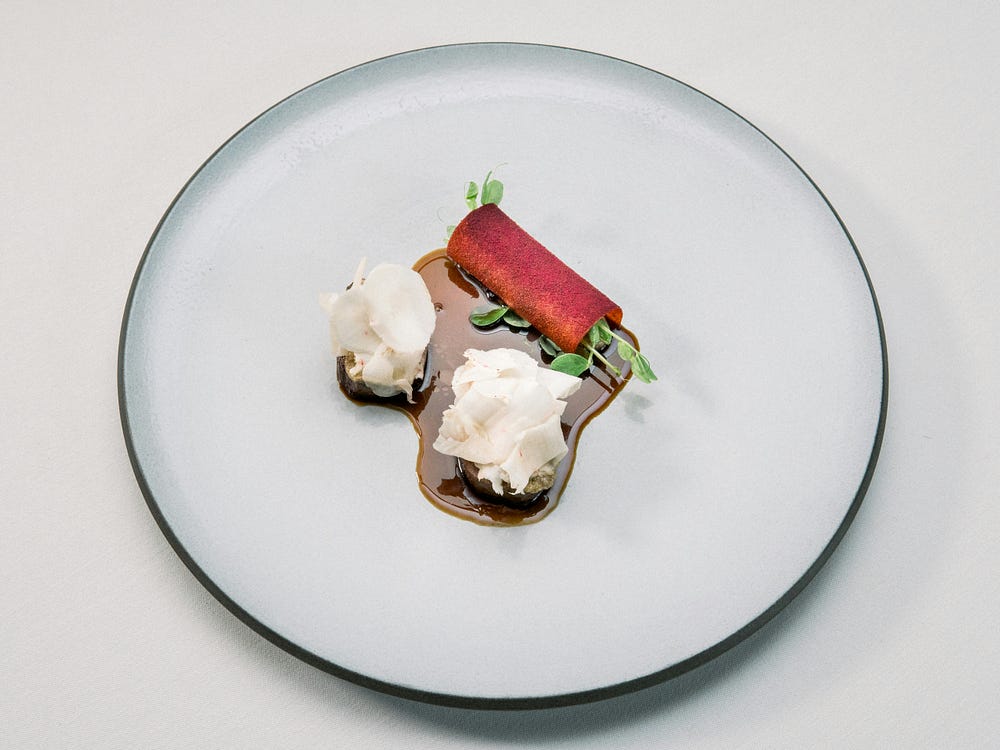
My first real boyfriend was twenty-nine and I was nine years under, with a love fever that needed more than broth and crackers. He spoke like a professor but cooked like a cult leader. Slow and serious, always claiming this would be the best thing I’d ever eat. Russian plov, ropa vieja, saffron threads that clung to rice like lint. He was a man who had a palette for chocolate, and who liked to watch my reactions like he was grading me on them. I barely liked him — let alone loved him — but there was something about being cooked for that made me feel chosen, even for a moment.
“Close your eyes,” he’d say, standing over me with a wooden spoon. “Whatcha think?”
I’d sit on the barstool at his kitchen island, my ankles crossed while slightly impressed. The cumin would hit first, then the smokiness, then something I couldn’t place — maybe sumac, or maybe his smugness.
The food stayed with me long after the man left. And even now, years later, I sometimes wonder if what I wanted most was the sound of a hush that falls when someone sets a plate in front of you and says, “This is for you.”
Solo date
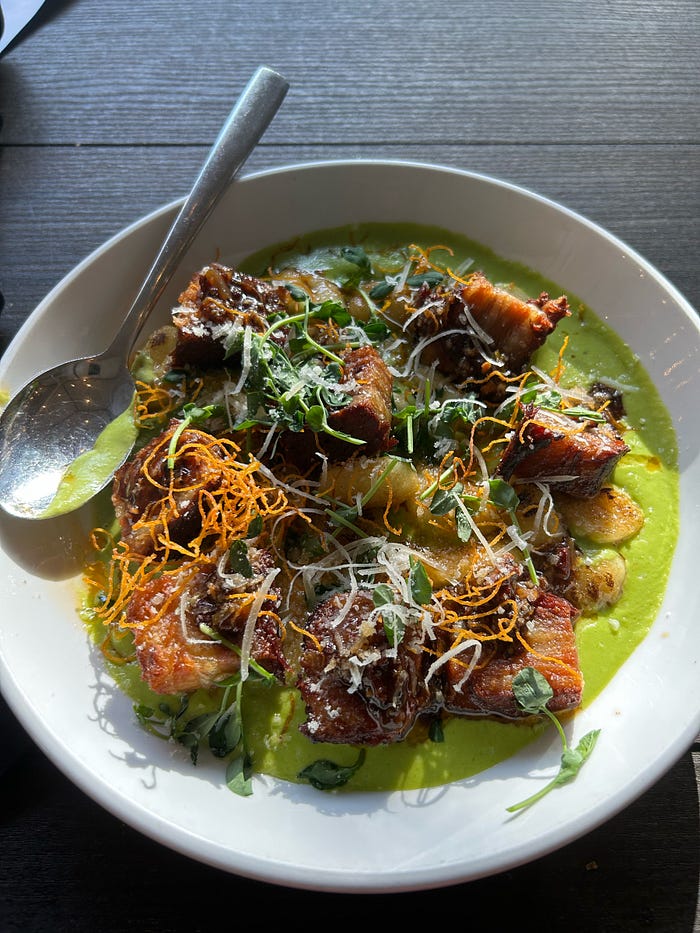
Last week, I took myself out on a solo date again to this gastropub in Houston, and I dropped thirty dollars on a pork belly gnocchi plate. My server said with the same vocal inflection as a salesman, “Pork belly is good! Had it for lunch today. You should try it!” Minutes later, it arrived steaming.
The plate filled with seared golden mini pillows beneath thick hunks of pork belly that glistened even in the shade, while sitting in a pool of lime green demi-glace. I was halfway through the bowl before I realized I felt something in my chest. Like my heart is trying to keep up with the pace of the rest of my body.
This is how I’ve always eaten. With desperation disguised as appetite, like I’m trying to fill a space that keeps expanding, no matter how much I try to fill it. Food isn’t neutral in my life. It’s currency and weapon, celebration and punishment. It’s what I turned to when everything else turned away.
And everything else has turned away. That’s the one constant I can count on.
Side dish
I come from a lineage where food carries the weight of everything we can’t say out loud. It fills the gaps when words fail, and when comfort has no place to land. In our family, we expressed love through cast iron skillets and mason jars of bacon grease saved as family heirlooms.
I remember the time my grandma and aunt took me to a catfish spot in Greenwood. I must’ve been six or seven, all elbows and questions. The place was dim, thick with the smell of hot oil and something else — something that made my chest tight. On one of the walls, a bear’s head snarled from above the counter, frozen mid-roar. Above it, fluorescent lights buzzing like the trapped insects in the windowsills of this place.
“Why you keep staring at that thang?” my aunt whispered, but I couldn’t look away. The bear’s glass eyes seemed to follow me as we slid into a booth with cracked vinyl seats.
Suddenly, tears erupted from my eyes, and I started getting lightheaded while scanning around the dining room. At the time, I didn’t understand why younger me caused “a scene” like that. Maybe because the bear looked so angry, or because the oil smell reminded me of my grandmother’s kitchen at five in the morning, or because of the pregnant man I saw, then all these pregnant old women or because everything felt too big and too small at once. My aunt shushed me, embarrassed by my tears. My grandma just pushed her plate away, barely touched.
Sometimes I think about how often I watched my grandma cook but rarely saw her eat. Whenever my mom or daddy would drop me off at her house in the morning, she would already be up cooking. She would always say she had been up since five or six. Without the sun’s permission, her hands already reached for flour and salt, prepared meals that could feed a congregation. Collards simmered low and slow, cornbread baked until the edges pulled away from the pan, chicken soaked in buttermilk overnight. But when it was time to eat, she’d pick like a bird — a forkful of greens, a sip of sweet tea, her attention always on everyone else’s plate.
I come from a lineage where food carries the weight of everything we can’t say out loud. It fills the gaps when words fail, and when comfort has no place to land.
“That’s all you gon eat, baby?” she’d ask me, spooning more rice onto my plate while hers sat in a pile.
Her hands, swollen from arthritis, moved like they were conducting an orchestra only she could hear. Even at rest, her fingers twitched like they were still stirring and serving. Her appetite was a matter she kept from all of us, including herself.
Her son, my father cooked with the force that needed to prove something to somebody. Enough force to “make you wanna slap yo own mama” or “knock grandma out with this here!” Sunday dinners were his sermons, neck bones and cabbage for his congregation. He’d stand over the stove, beer in one hand, wooden spoon in the other, tasting and adjusting until the juices was perfect.
“Come here,” he’d call to me, holding out the spoon. “Who is the Chef BoyarDEE?” a question he shouted to verbally emphasize the sound of the first letter of his government, yet non-trademarked name.
The broth would be rich and smoky with an aroma that made your sinuses clear just from breathing it in. I’d nod seriously, like I was judging a cooking competition, and he’d smile — one of the few genuine smiles I remember from those years.
But, he and my grandma both had their own ways of saying, “ I need something sweet to eat.” My father with sugar and alcohol, my grandma with all salt and silence. Diabetes runs through our bloodline like an old wives tale. The story changes with the person, but everyone seems to know the ending.
My father’s done the same thing I do, only quieter. He builds altars out of fast food bags and Mountain Dew bottles. I found honey buns in his truck once, wrapped in plastic like secrets. He looked at me like I was holding something sacred. Then he laughed.
The side dishes fill the table, make the meal complete. But in my life, they’ve always been the moments that reveal the most — the untouched plates, the careful portions, the way we feed others what we won’t allow ourselves. The spaces between the words we want to say.
Main course
The first time I threw up on purpose, I was thirteen and rail-thin, ribs showing through my school uniform. I’d eaten a sleeve of saltines after school, then panicked about the calories. The bathroom tiles were cold against my knees. I was already skinny, but my looks was the only thing I could keep under control when everything else was chaos.
“You need to eat more.” my daddy would grunt, watching me push food around my plate. But eating felt dangerous, like stepping off a cliff. Better to stay small, stay safe, and stay in control than to risk something else falling apart.
The summer I turned sixteen, I spent three weeks eating nothing but what I could hide. My father would let me know how angry he was every night — my mom, money, work, the weight of trying to keep us afloat in a town that was designed to sink. After he would pass out from his four-hour lecture, I’d slip away to my room with whatever I could carry.
Sometimes dinner was a bag of leftover Shipley’s donuts devoured before dad got home. Other times, I rationed air. One granola bar had to last the whole day. I didn’t call this anything. I didn’t name it. It was just how I lived. Just how I kept the walls from folding in.
The worst part wasn’t the overeating or the restriction, but sitting still after the ravaging and feeling nothing shift inside.
After graduating, I remember going to the YMCA track and circling it over and over again like I was orbiting something — myself, maybe? Or some future version of me I hoped to run into?
I would walk for hours, under the punishing heat of the Mississippi Delta sun, headphones in, legs burning, hoping the movement would undo something in me. Maybe if I kept walking long enough, my body would return to me in a way that made sense.
Sometimes dinner was a bag of leftover Shipley’s donuts devoured before anyone dad got home. Other times, I rationed air… I didn’t call this anything. I didn’t name it. It was just how I lived.
I’d be lightheaded from not eating, a sip of water sloshing in my gut like a secret. Afterwards, I’d reward myself at Pasquale’s — the local food joint just down the block from the track — and order burger and wing platters without hesitation. I never needed an excuse. The hunger was the excuse.
I called this a “gap year,” though there was nothing expansive about it. It was a year of bed-rotting, walking, eating, repeating. I told myself I needed time to rest and figure things out. But rest only feels like rest when you have a sense of peace to return to. Mine had long since disappeared.
Consequently, this cycle caused distortion in myself where I started looking at my body as if the bio clock could freeze at any moment now. I began wearing the same three outfits over and over again, because the clothes were the only things that “looked good” on me.
I began to shrink in every way that didn’t involve food. I made myself small even in bite-sized conversations. I avoided mirrors. I refused invitations I wasn’t even receiving. And somewhere along the line, I stopped asking for anything, whether it was food, help, or love. At some point, they start becoming synonymous anyway.
Dessert
I turned twenty-three inside of an art museum’s Michelin star restaurant where the walls gleamed like porcelain and the silverware clinked with surgical precision. I’d made a reservation a week in advance even though no one was coming. But still, I wanted to convince myself the night mattered.
“How many is it?” the hostess asked, scanning the space behind me.
“Just me.” I answered, and watched her eyes fall like a mouth to the floor.
She seated me at a corner table, tucked away. Tucked away is how I like it, cozy. I wore a black dress that hung loose in places it used to fit, my hair pinned up to expose the sharp angles of my collarbones. I’d spent an hour on makeup, blending and contouring like I was painting myself back into existence.
I chose the three-course seasonal menu, because why not. Course by course, each plate arrived as miniature canvases. The waiter described each dish with the cadence of a museum guide, but I retained nothing. My mind was elsewhere, counting the empty chairs at nearby tables, watching couples lean into each other over shared appetizers.
“The mushroom and corn risotto,” the waiter announced, setting down a plate with an orange pudding of rice garnished with charred corn and mushrooms. “Inspired by autumn in Italy’s countryside.”
I nodded and took a spoonful. The rice was creamy, earthy, tinged with truffle oil that coated my tongue. Once the taste dissipated, there were notes left of the sound of my own breathing in an empty apartment.
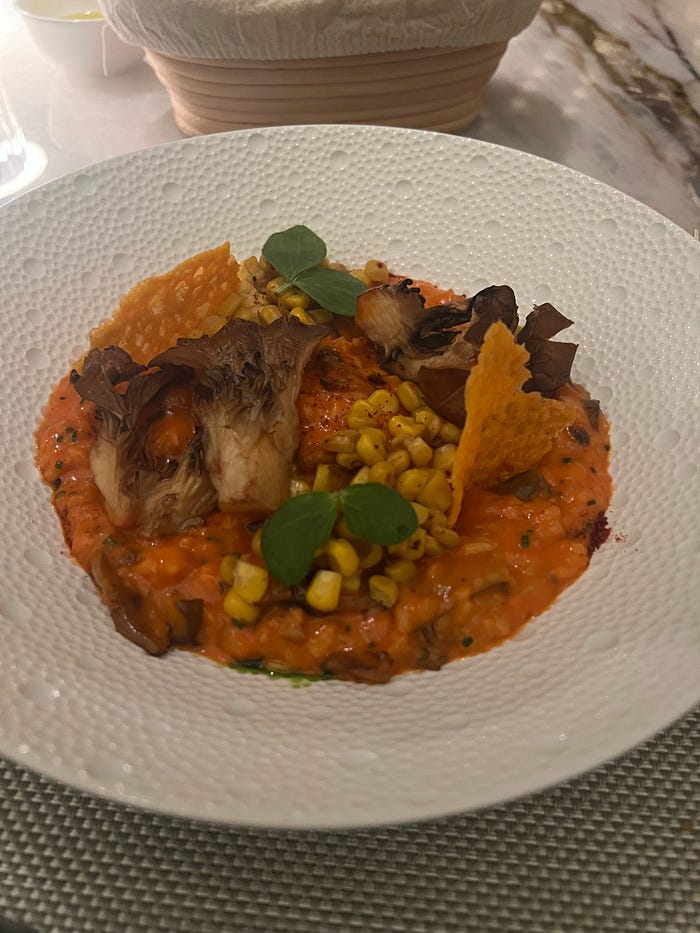
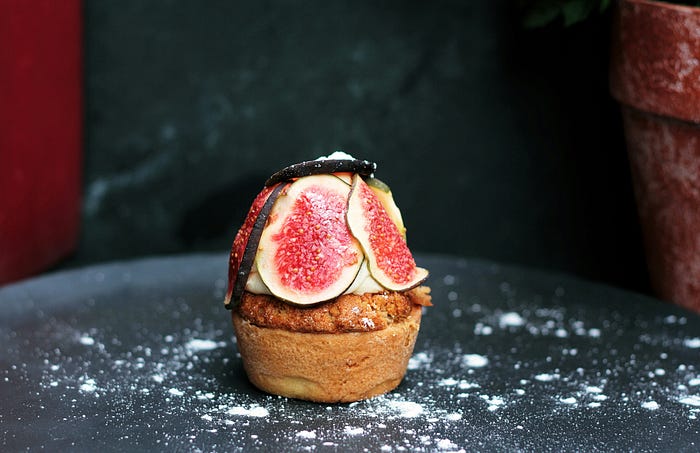
Each course arrived with a less generous portion. By the time dessert came — a fig tart that can be held in a child’s hand — the night was getting older in ways that had nothing to do with my hunger.
“Happy birthday,” the waiter said, placing the tart in front of me.
A smile crept up on my face, the way you smile after being slapped and handed a napkin afterwards. The tart was gone in two slow bites. I sat there for another twenty minutes, nursing my wine, as the restaurant emptied around me.
My solo celebration came to a conclusion and I ubered back home. My driver’s country music playlist grinding against concrete, my stomach tight with expensive food that had filled nothing. When I got to my apartment, I stood in front of the bathroom mirror and cried as I wiped off my makeup. Then I microwaved a bowl of dumplings and sat in front of my TV, and called it a night.
Little Hunger
I’ve been thinking about the women on television who mirror something I recognize in myself. In the movie Burning (2018), Haemi, the lead female character, strips bare against a dying light; her body becomes a prayer dance written in shadow and gold hues. She moves like water finding its way downhill. In the film, she speaks of the African Bushmen tribe’s wisdom: two hungers carved into the human heart. Little Hunger claws at your belly. Great Hunger devours your soul.
I sat on my couch, knees tucked tight against my ribs, and something cracked open inside me. Little Hunger had walked beside me on those brutal Mississippi runs, my stomach hollowed out, old leather split lips, nursing just enough water to keep my legs moving. I’d tasted it in the sharp mathematics of counting change for a sleeve of crackers, rationing hope like it might expire any day now.
Little Hunger is being Black and young and living on your own in a town that forgot your name the moment you stepped off the sidewalk.
But Great Hunger lived deeper. It made me press myself against anyone who’d let me, clutching at strangers like they held the secret to breathing. Haemi gravitates toward Jong-soo, the boy who crushed her younger self with casual cruelty. Then Ben appears — all expensive cologne and empty promises, offering her glimpses of a life that shimmers just out of reach. She’s in debt, severed from family, burning with questions that have no answers. Her hunger goes beyond, but is proof that she exists. Until, she literally disappears.
Then there’s Sydney from The Bear, wielding her knife like it could cut through all the noise. She doesn’t chase love or even a Michelin star — she hunts for mastery. But the kitchen becomes a battleground under Carmy, a man so wrapped up in his own wounds he can’t step past them. He barks orders and swallows her sentences whole, leaves her to untangle messes she never made. Sydney bleeds into the restaurant — her sleep, her peace, her dreams of something greater. She shows up before dawn, stays past midnight, and sharpens her blade until her fingers cramp.
That hunger lives in my bones too. The way it eats at me from the inside, the need to prove I belong in rooms that never wanted me there. I’d stayed late at jobs that ground me down to nothing, hoping someone would finally say the words, “You’re good. You’re enough. You can rest now.” Sydney’s hunger feeds on purpose, on the promise that someday her culinary vision will mean something.
And then, we have Dre in the television series, Swarm.
She consumes everything. Bodies, souls, music, and gas station candy that sticks to her teeth. After her first kill, she tears into a cherry pie with blood still smeared on her hands, and the way she eats it — I can’t even describe. Can’t make out whether it was like a feral animal or a caveman at the cusp of his humanity. This scene out of the few others shows she doesn’t eat for pleasure. She eats to survive the aftermath of her own fury, to remember what it means to swallow something willingly. An orphan abandoned by everyone who should have loved her into wholeness, but instead she’s let neglect shape her into something the world can’t name as human.
I’m not Dre at all. But I know the spiral that drives her — that white-hot rage that lives behind teeth, the way walls become armor when tenderness cuts like a blade. Instead, I’ve chosen silence over softness because softness gets you hurt. I’d learned to starve my own wants until they whispered instead of roared.
These women are all versions of the same story of what happens when female appetite gets twisted by abandonment, by the learned belief that our needs are burdens, that our desires are dangerous. We become either obsessively controlled or completely chaotic, either invisible or so seen that you disappear.
Dessert is supposed to satisfy completely in its look and taste. But for women, satisfaction is complicated by the question of whether we deserve it in the first place. To question the conception of the question, “Should I treat myself?” Every bite we take carries the weight of judgment, every moment of fullness overshadowed by the possibility of punishment.
Aftertaste
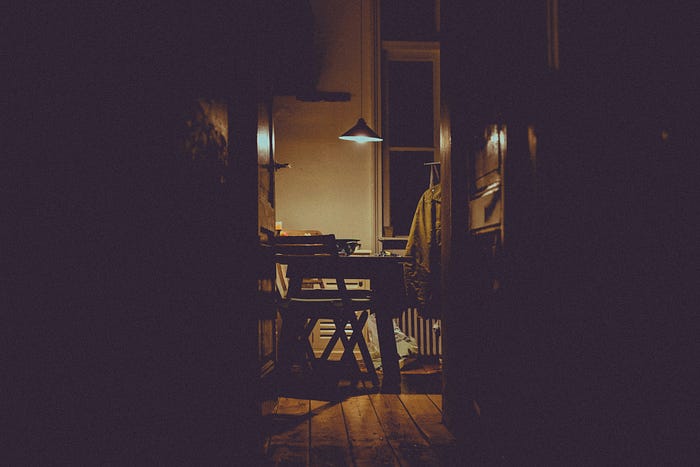
Lately, I’ve been trying not to eat at night. I brush my teeth early, wash any dishes by ten, turn the lights off in the kitchen like that’s enough to make the cravings dissolve. I tell myself the day is over, and I already had dinner. “You know better now” as I tuck myself into bed.
But after eleven, I start hovering. I open cabinets just to check for food or permission maybe? The voice sends me back to bed and I scroll Pinterest instead. I fall into a loop of women with collarbones sharp enough to slice oranges, arms thin enough to disappear inside coat sleeves, and visible thigh gaps. My Pinterest board is full of the images I hate myself for loving. I start bargaining, “if you want to look like that, then you don’t get to go back into the kitchen.”
This time it isn’t any bingeing or smashed plates, but shame that sits quietly. And it sounds like, “You did good. You stayed out of the kitchen. You were strong.”
But the craving doesn’t leave. It just changes shape. It sharpens behind my ribs, settles into my chest, sits beside me like a woman in a dress too tight to breathe in. Smiling with her legs crossed, she doesn’t eat the cookies. And I watch her. I wait. She has enough.
Thank you for reading this piece of my soul. If you would like to read more of my essays and poetry, visit my website or follow and subscribe to my Medium here. You can find me on Instagram as well @dsmithwrites.
 D.Smith Writes