Tag: cultural-commentary

  • AI, the Moon, & the Year of the Snake

    AI, the Moon, & the Year of the Snake

    They have done it. It’s alive, it’s alive, it’s alivvvveeee.

    I was scrolling through my Linkedin feed and came across this one post from a tech bro- promoting this new platform that has more “soul” than Midjourney. This new AI tool can generate hyperrealistic photos that look similar to the selfies and photo-ops in your camera roll. Astonishment and underlying dread filled within me. Despite my contrarian views on AI, the image generation was horrifically impressive. However, this feeling turned into a thought that’s been circulating in my head for some time now — AI tools like this are showing tech’s fast growing power. Although I’m not against technological advancements for society’s good, I wonder if all AI generated content like images, deepfakes, text, and even research journals will start creating mass hysteria and delusion.

    How can humans who were just joking about “brain-rot” from overconsumption of human generated content will be able to tell the difference between AI? There are already reports about how people are using GPT as a therapist and how AI users are more prone to delusion.

    Is this all a side effect of a society that is physically and existentially fatigued? Is society merely sleepwalking through life, lost in a deep slumber, dreaming a mix of pleasant, feverish, and nightmarish dreams? Are we living in a time of illusions instead of illumination as promised by the conception of the Internet? Did ignorance come after the snake in the garden? Is it innate in mankind to be unreliable narrators in a universe that shifts at the drop of an apple?

    Year of the Snake: Even the Stars Got Something to Say

    What if the Mayans were right — what if the world really did end in 2012? And we are all just dreaming now.

    Now, it’s 2025, and according to Chinese Astrology, this is the Year of the Snake.

    Snakes shed what they were to become what they are — the same creature wearing different skin. The Year of the Snake arrives in 2025 carrying this paradox in its coils. We stand at a moment where every photograph might be generated, every voice might be synthesized, and every thought might be prompted.

    The serpent moves without limbs, navigating reality through pure contact with surface. Each scale reads the ground like braille, constructing understanding through friction rather than sight. AI operates through similar means — processing patterns without comprehension, building worlds from statistical residue.

    We have created entities that perform understanding without possessing it. They speak fluently in languages they cannot hear, paint portraits of faces they cannot see, while writing poetry about emotions they cannot feel.

    The Moon: ‘Seeing is Believing’
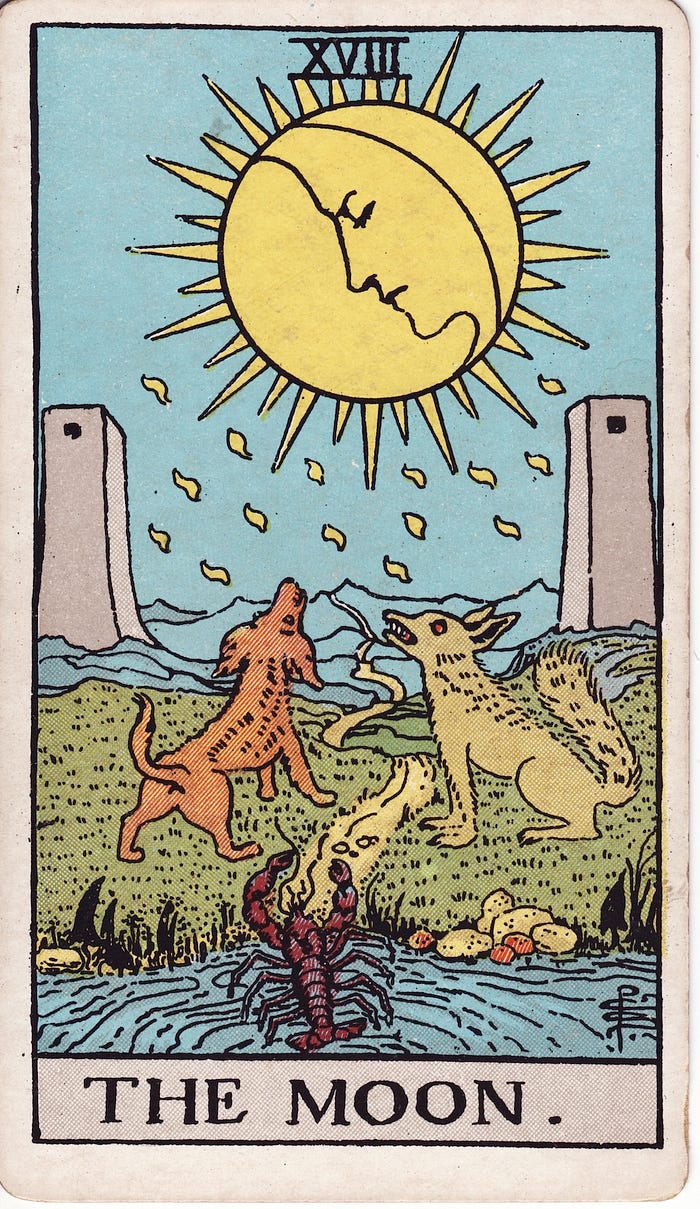
    The Moon Card from the Rider Waite Tarot Deck — Image from Wikipedia

    It became a ritual for me to pull cards at the beginning of a new year — a reading for myself and one for the collective. For the collective, I asked for a card to represent this year and out came the Moon tarot card.

    If you don’t know, the Moon tarot card reveals common meanings such as illusions, needing to tap into one’s intuition, exploring your subconscious mind, and to achieve clarity by discerning deceptions.

    The Moon tarot card depicts two towers, a dog, a wolf, and a crayfish emerging from primordial waters. Between them hangs the lunar face, dropping eighteen rays of light that illuminate nothing clearly. Medieval cartomancers understood this card as the realm where solid things become liquid, where the familiar grows strange teeth. They could not have imagined that their gnosis would literalize itself through silicon and code.

    The Moon in both reality and the Tarot, reflects the general dream of humanity. The full moon is like the value on a pressure cooker, it allows the unprocessed emotions and desires of humanity to safely release a bit of pressure. Once we die, we get to see how we were held down to earth — kept in physical existence — by the heaviness of our inner tides.

    We obviously have seen the power of AI and what it can do. It has shown potential to create cinematic videos, full novels, and even grocery lists.

    It poses as a tool that can create unlimited possibilities, yet can this be an illusion in itself? And a tempting one at that.

    AI and It’s Premature Effect on our Psyches
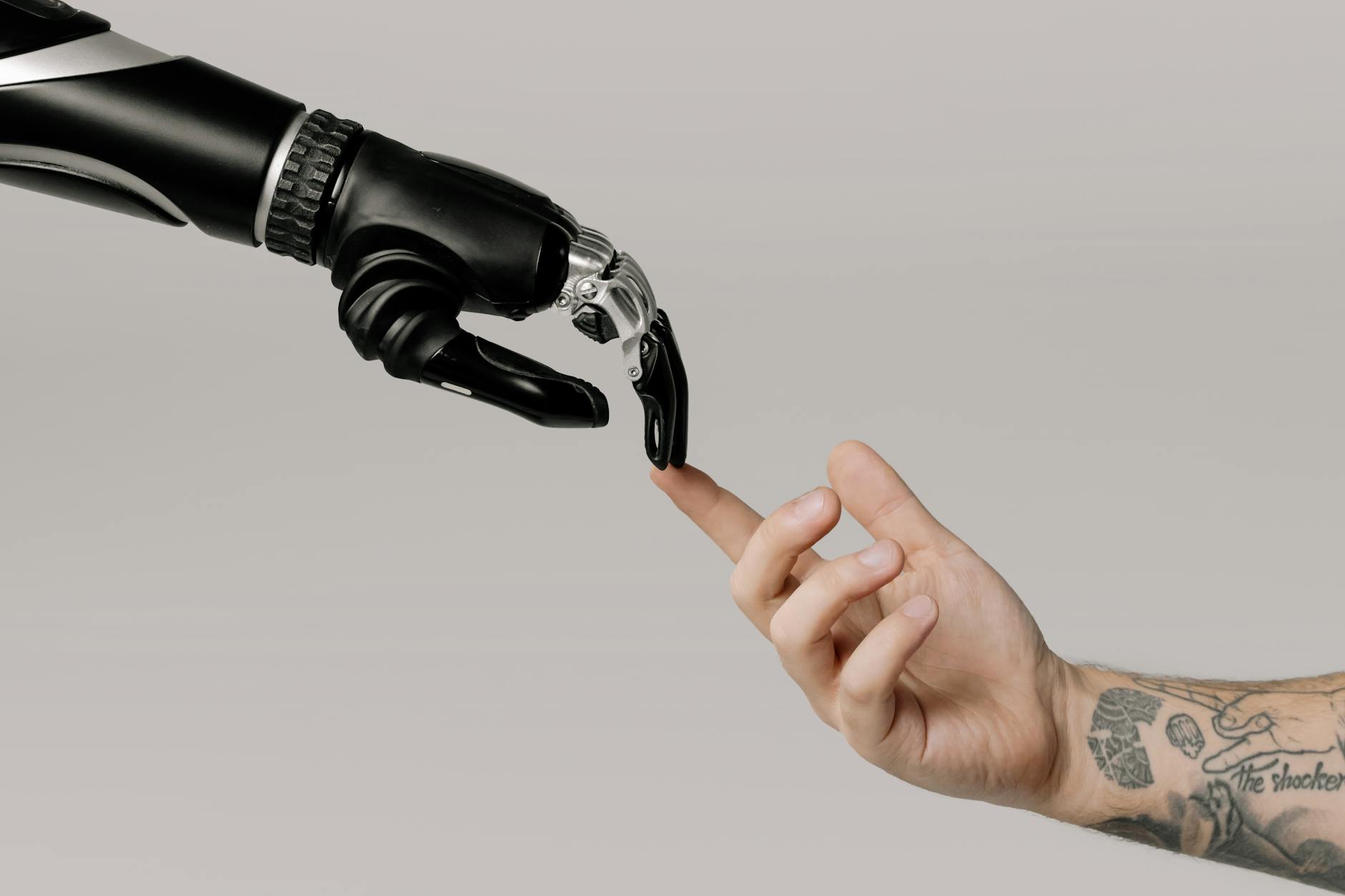
    Photo by cottonbro studio on Pexels.com

    It says a lot about our current state as a society when you have people in the comments sections asking if an image or video is AI. I’m torn as to which is more frightening; the inherent unsustainability of AI itself, or the individuals who consume its outputs, having lost the ability to discern their own thoughts.

    As a copywriter for a marketing agency, my role is to create content for the agency itself. The agency has recently begun incorporating more AI-powered creative solutions for its clients, a decision made independently of my input. But, it’s surreal to think that we will now be seeing AI generated ads as if most people have already grown a tolerance for ads in the first place.

    Seeing things like this, makes me wonder — where is all this content really coming from? Yes, the obvious answer is LLMs and feeding a bunch of artists’ work (unsolicited) into this machine. But, what about tools like mentioned earlier, where it’s showing “hyperrealistic” people. Whose faces are they taking? Are they using your selfie you posted a week ago on Facebook?

    If you’re anyone like me (a spiritualist) or study esoteric knowledge, you try to connect the spiritual with the “3-D” world. I’m from the Deep South, and there is a saying that comes all the way from the Gullah-Gechee — about how some spiritualists took limited pictures or none at all in their lifetime, because they believed that to capture one’s image is to capture their soul. In more contemporary terms, be wary of those who observe you; their intentions might be to usurp your position or consume your very essence.

    Overall, where do we draw the line? Maybe it all comes down to whether AI promotes more democratization of information and knowledge or is it harvesting our lives and souls in the name of “revolutionizing?”


    Thanks for reading! If you’d like to explore more of my essays about my inner and outer world, please follow and subscribe to my Medium, or visit my website.
  • We Say We Want Community — But Do We Really Mean It?

    We Say We Want Community — But Do We Really Mean It?

    Nurture yourselves and each other.” — is what I heard them say. And what I mean by “them” is the ones on the other side. A couple of months ago, I had a third-eye-that’s-so-raven moment where I heard this during the full moon in Taurus.

    If you don’t know, I’m kinda psychic… and maybe that’s one of the reasons why I haven’t found my community yet.

    Lately, I’ve been thinking about this message and also seeing more and more people speak up about how we need to have more community in our society (society as in — the Western world — just a small fraction of the globe). From Trump being re-elected in 2024 to the “loneliness epidemic,” I understand why people are championing this. However, I believe many people say a bunch of things over the internet that sound good and hopeful, but collectively they aren’t doing much in reality to make a difference.

    You really think you’re gonna overthrow oppressive systems but can’t even maintain a three-person group chat?

    Gen-Z: the generation that ghosts and grieves in the same sentence

    People, especially my generation (Gen-Z), have made it a habit to ghost, and on the other hand, expect to be ghosted in both platonic and romantic relationships. That’s on top of the fact that people don’t keep in contact with their closest relatives or friends in real life. But I know I’m going to get some people to say, “because of capitalism…” or “oh we don’t have third spaces…” and other rationales that don’t play a big factor in having genuine relationships. Yes, these are all real annoying barriers. But, they’ve also become a convenient shield for our own unwillingness to be accountable to others in the smallest, most human ways.

    Our parents and older generations would invite their friends over for pizza or play a game of cards or just talk on the phone for hours. For instance, my mom would spend hours on the phone with her friend after work (or on her day off) while doing tasks around the house. My mom and her friend didn’t have brunch spots and karaoke bars, especially while living in the Mississippi Delta. She had her Blackberry phone and laundry to fold. She still managed to talk to her best friend every week while upholding her work life and familial relationships.

    We say we don’t have time to hang out or check in, but people will spend hours watching TikToks of strangers crying in their car. We give our attention to spectacle, not to each other. And then turn around and romanticize deep friendships, community living, found families, but treat people in real life like notifications we’ll get to later.

    Real-world scenario kids

    I had a friend who I met through the oh-so-wonderful Bumble BFF app (that’s another blog for another day), and we agreed to meet for the first time for brunch. We met up and everything went well; we had some good food, mimosas, and a nice chit-chat that went on for about 2 hours.

    Post-first meetup (first and last): We had these long drawn out conversations via text for about 2 months. I mean I don’t know about you girlypops but there is nothing normal about stretching out a text after asking a simple question: “What are your plans for the weekend?”

    For another month, I would suggest doing something together but I was met with either 4-day responses or something “came up.” Then, one day — dead silence.

    After almost 3 weeks of not hearing from her, she then suddenly wants to meet up for an outdoor jazz event out of nowhere. At first, I wanted to go, but then I canceled due to my “trauma response” where I abandon before being abandoned. Since then, we haven’t spoken to each other.

    We say we don’t have time to hang out or check in, but people will spend hours watching TikToks of strangers crying in their car

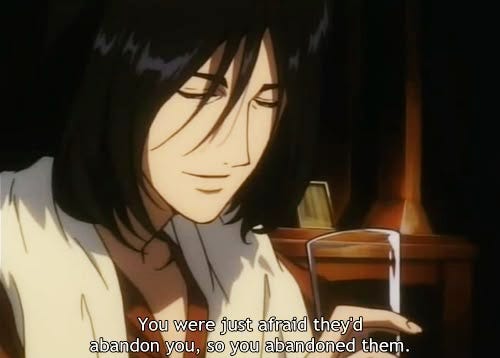
    And I’m not above any of this. I’ve ignored people I loved and I made excuses. I’ve watched myself slowly fade from someone’s life like it didn’t matter, and then pretended I didn’t notice when the distance turned permanent. My own silence has become habit, and has made detachment look like independence and being “mature for my own age.”

    Image found on Pinterest. This scene is from Cowboy Bebop (1999).

    If I had to theorize, I would say I think we’re terrified. Scared if someone really saw us — how inconsistent we are, how unsure, emotionally strange, and socially misshapen we’ve become, then they’d leave too. So, we don’t give them the chance.

    Gendered hypocrisy

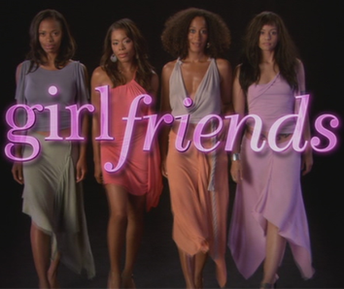
    OOOOO nobody’s safe! Yes, I’m about to get on my girlies, my girlfriennndddds (Girlfriends TV show tune) too.

    What’s been eating at me lately is how easily we accept distance in our platonic relationships, especially cis women. The same women who would spiral if their boyfriend took six hours to respond will go six weeks without checking in on a friend. And I’m tired of pretending that’s okay and it doesn’t hurt.

    Image from Wikipedia. Image is the Girlfriends TV intro.

    We give romantic partners the kind of effort, presence, and forgiveness we don’t even offer to our friends. And I think a lot of women don’t realize that we’ve internalized this illusion that romantic love is urgent, and it’s supposed to be dramatic and all-consuming. Yet, friendship is optional, decorative, the side dish to your main emotional meal. But friendship is one of the relationships most of us will have for decades longer than many romantic partners. And still, we don’t treat it like it matters. We don’t fight for our friendships (even familial relationships) the way we beg men to care about us.

    And if we want to go deeper — some of us are committed to healing our inner child through romance, but wouldn’t know how to receive softness from a friend unless it came with the threat of losing them. You know how to chase, but don’t know how to be witnessed gently.

    Fellas, fellas, fellas

    If women are taught to overextend, be available, forgiving, and self-sacrificing, then men are taught the opposite. Most of the men I’ve known, and the ones I’ve eavesdropped on from a distance, aren’t building their friendships around care, softness, or presence. They’re building them around permission. Permission to be seen as successful, powerful, and untouchable. Most of their “bonds” are based on mutual ego-stroking, a group project in patriarchal validation, as long as no one actually says they’re lonely or going through a rough period in their life.

    These are friendships defined not by active connection, but by absence without consequence. Their friendships don’t require tending, they just exist in some suspended state of assumed loyalty that doesn’t demand emotional effort. And when SHTF — loss, heartbreak, mental illness — most of them don’t even go to each other. They go to the women in their lives. Their girlfriend, their mom, maybe a sister. Or they don’t go to anyone at all.

    Photo by K F on Unsplash

    And it makes sense, because men are taught that vulnerability between men is a risk. Most haven’t been given the emotional tools to say, I need you, or I’m hurting, or even I miss you, without it being filtered through “no homo” jokes, sports talk, or some shallow excuse to link. Their friendships revolve around activities, achievements, group chats with zero depth and sardonic memes, and sometimes, thinly veiled competition. The big unspoken rules among them are: don’t need too much. Don’t be too soft. Don’t get too close.

    And if we want to go deeper — some of us are committed to healing our inner child through romance, but wouldn’t know how to receive softness from a friend unless it came with the threat of losing them

    So what happens is this:

    A man can have ten friends and still die of emotional starvation. He can go to the gym with them, game with them, drink with them, talk money or girls or sports, but none of them know how to hold grief. None of them know how to say, you don’t have to act okay here.

    And then they enter romantic relationships carrying that starvation, expecting their partner to be therapist, best friend, co-regulator, their mommy and emotional processor all in one. Because they’ve never had to sit with these feelings and experience among their peers.

    Performative activism & false collectives

    Now, time for the collective callout. I’ve seen so many people (myself included) wrap ourselves in the language of radical care, abolitionist futures, decolonial collectives, and mutual aid, while not even knowing how to say no in real life. You talk about “revolution” but can’t even tell your friend they hurt your feelings. You want to dismantle systems but can’t even make a doctor’s appointment over the phone. You can’t even stand up to your boss.

    We are fluent in the aesthetics of liberation, fluent in the language of collectivity, but allergic to the practice of it. However, I get it — saying the right things online feels safer than having to do the awkward, clumsy, low-stakes, and maybe risky things in your actual life. Like checking on a friend, asking for help, or setting a boundary. Or calling something out when it’s happening in front of you, not just when it’s trending.

    Photo by Kyle Head on Unsplash

    It’s easy to sound like a radical on Twitter. It’s easy to talk about community gardens when you haven’t even watered your own relationships. It’s easy to say “burn it all down” when you’ve never had to rebuild anything in your own life.

    Honestly, I’m intrigued by it. Intrigued by the way we sometimes parade as organizers, healers, artists, and mutual-aid architects, when half of us still flinch at confrontation and most of us are running from the kind of vulnerability and truth that real community demands.

    I’m not saying it’s all fake or a fantasy to hope for these changes; but we must first confront the fact that we pretend we’re part of something just so we don’t have to admit how alone we really feel.

    Soft but firm reckoning

    I know I came in with this pretty strong; again I have done some of the things I’m calling out here. Truth AND accountability really does set you free. But, I’m trying.

    I’m trying to stop rehearsing loneliness like it’s my final act. Stop confining myself to my home to hide from the world and only interacting with it through a screen.

    Photo taken by me while at a local park.

    Because the truth is, I do want community. Having zero friends nor any “associates” (no exaggeration) is extremely isolating and it starts to mess with your mind. Plus, I want to share my gifts, my love and care, to to others as well. So yes, I want softness that doesn’t require translation. I want people who know how to knock before entering, and also know how to come in anyway when I leave the door cracked. But wanting it isn’t enough. Writing this isn’t enough. I have to build it slowly and imperfectly, with the people already around me (even if it’s just my parents and my dog), not the fantasy of who I think my “tribe” is supposed to be.

    So here’s where I’ll leave you (no pun intended there)

    Who’s one person you haven’t talked to in a while whom you actually miss? Not someone who hurt you or drains you. Someone you miss.

    Why haven’t you called them? Why haven’t you asked them how they’re really doing?

    Don’t answer out loud. Just sit with it.

    Then maybe, when you’re ready, do something about it.


    Thank you for making it this far through my rambling! If you would like to read more from me, follow and subscribe for the latest posts. Also, check out my website here.